
ACOP L8 is the HSE's Approved Code of Practice titled Legionnaires' disease: The control of legionella bacteria in water systems, now in its fourth edition (2013). You'll also see it written as ACoP L8, HSE ACOP L8, or simply L8. These all refer to the same document.
It sets out how duty holders, including employers, landlords, and anyone in control of premises, should identify, manage and control the risk of Legionella bacteria growing in water systems such as hot and cold water services, cooling towers, and spa pools.
ACOP L8 isn't law in itself, but it carries quasi-legal status alongside the Health and Safety at Work etc. Act 1974, the Control of Substances Hazardous to Health Regulations 2002 (COSHH), and the Management of Health and Safety at Work Regulations 1999. In practice, following its guidance is the clearest way to demonstrate legal compliance, and it's exactly what we help our clients achieve.
If your premises use or store water and there's a realistic chance of water droplets being created and inhaled, ACOP L8 applies to you. We work with duty holders across the sectors where Legionella risk and enforcement attention tend to be highest, including:
Commercial and industrial properties
Hospitals and healthcare settings
Hotels
Schools and universities
Leisure facilities, spas and swimming pools
Whatever sector you operate in, our assessments are tailored to the specific water systems on your premises, not a generic checklist.
ACOP L8 places five core legal duties on every duty holder. Here's what each one involves and how our services are built to support you through it.
Identify and assess sources of risk
This is where it starts: a thorough Legionella Risk Assessment of every water system on your premises, carried out by our qualified assessors.
Prepare a written control scheme
Once your risks are identified, we help you put a clear, documented control scheme in place, setting out exactly what needs to happen and how often.
Implement, manage and monitor precautions
Our Temperature Testing & Monitoring service, supported by our Mobile App Software for Testing, keeps your control measures active day-to-day rather than sitting untouched on a shelf.
Keep records of all precautions
Through our Reports & Compliance Documents service, we make sure your risk assessments, monitoring results and remedial actions are properly documented and retained, protecting you if you're ever questioned or audited.
Appoint a competent, responsible person
Our Training & Accredited Courses give your appointed responsible person the knowledge and confidence to manage Legionella risk effectively, whether they're new to the role or need a refresher.

A Legionella risk assessment is mandatory for every water system with the potential to create and spread breathable droplets. There's no exemption based on the size of your organisation. Here's how we approach it:
1. Initial consultation and site survey
We start by understanding your water systems and specific concerns, followed by a thorough on-site survey of your premises.
2. Risk identification and evaluation
We assess every relevant water system, including hot and cold water services, cooling towers and any other outlets that could harbour Legionella, checking temperature, stagnation and biofilm risk against HSE guidance and the BS 8580 framework.
3. Control measures and action plan
You receive a clear, prioritised action plan covering temperature control, flushing regimes, water treatment and disinfection: practical steps, not a generic list.
4. Ongoing monitoring and review
Compliance doesn't end with a report. We offer continued inspections, testing and system reviews to keep your water systems legionella-free year after year.
Depending on what your risk assessment finds, our team can put a range of proven control measures in place, including:
Temperature control: hot water stored at 60°C or above, distributed to reach 50°C at outlets, with cold water kept below 20°C
Preventing stagnation: regular flushing of low-use outlets and removal of redundant pipework
Cleaning and disinfection: descaling and disinfecting tanks, showerheads and other components
Water treatment: chlorination, UV disinfection or biocide dosing where appropriate
Ongoing monitoring: our Temperature Testing & Monitoring service confirms controls are actually working, not just documented
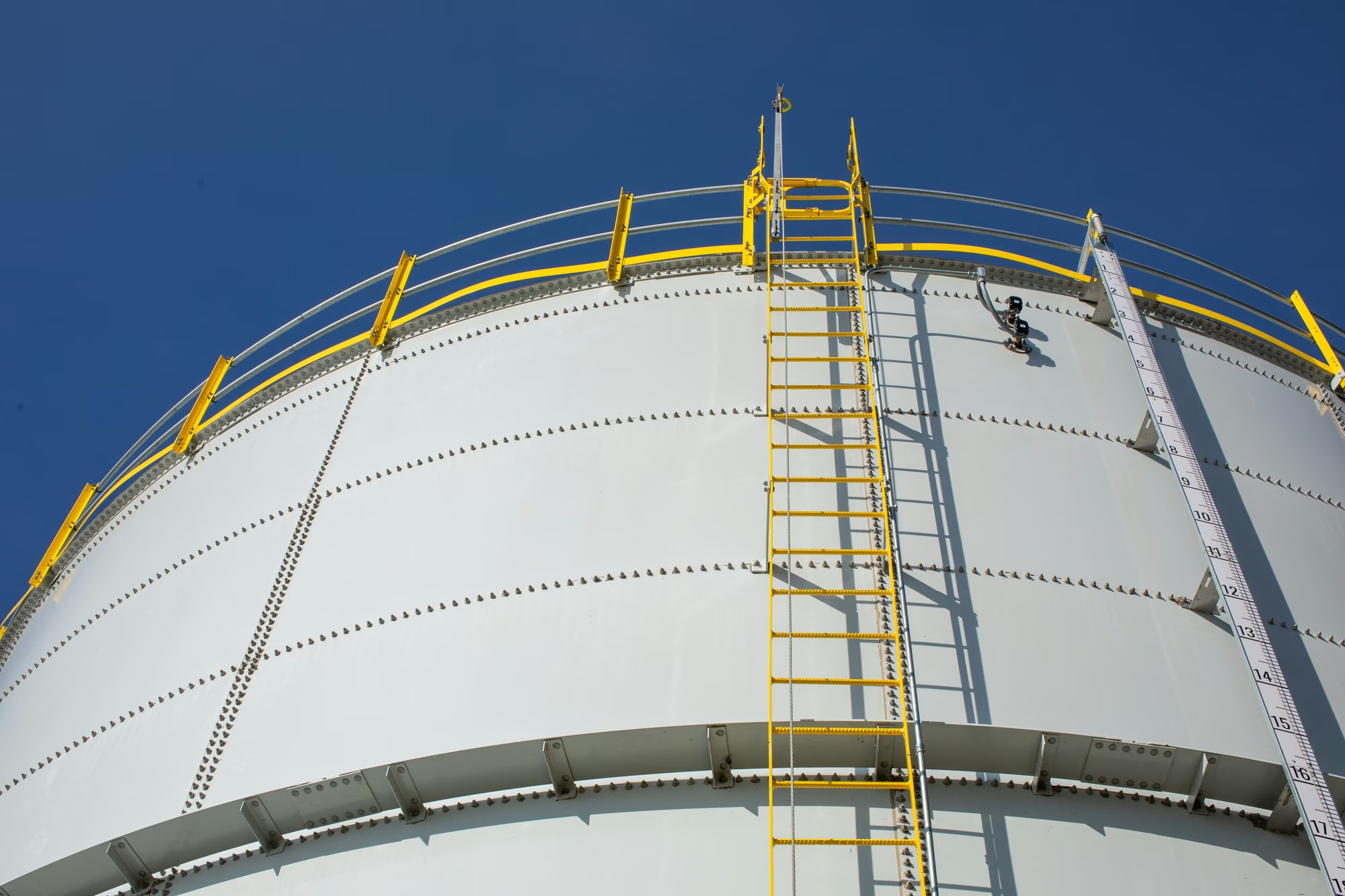
ACOP L8 sets out your legal duties as a duty holder. The technical detail of how to meet them sits in two companion documents: HSG274, covering evaporative cooling systems, hot and cold water systems, and other risk systems; and HSG282, covering spa pools specifically. Our assessments and control schemes are built around both, so you're covered whichever type of system you're managing.
Falling short of ACOP L8 isn't just a compliance risk. HSE inspections can result in improvement or prohibition notices, and serious breaches can lead to prosecution, substantial fines, and lasting reputational damage. More importantly, poorly managed water systems put real people at risk of a serious, preventable illness. Our role is to make sure that risk never materialises. We do this through proper assessment, clear action plans, and consistent follow-through.
Expertise you can trust
Our team is fully trained and experienced in handling water systems of every size and complexity.
Full regulatory compliance
Every assessment we carry out aligns with the HSE's ACoP L8 guidance and the BS 8580 standard, with clear documentation to back it up.
Tailored to your building
No two water systems are the same, so we don't apply a one-size-fits-all assessment. Every report reflects your specific premises and risks.
Support beyond the report
From monitoring and testing to training and compliance documentation, explore our full range of Legionella compliance services to see how we help you stay compliant long after the initial assessment.
.webp)
Interested?
Get in touch.
Lorem ipsum dolor sit amet, consectetur adipiscing elit. Suspendisse varius enim in eros elementum tristique.
How long must compliance records be kept?
At least five years is best practice, and a written risk assessment record is a legal requirement if you employ five or more people. Our Reports & Compliance Documents service keeps this all in order for you.
Who should be the "responsible person"?
Anyone with sufficient authority and knowledge of your water systems, provided they've had appropriate training, whether that's a member of your own team or supported through our training courses.
What's the difference between ACOP L8 and HSG274?
ACOP L8 sets out your legal duties; HSG274 provides the technical guidance for implementing controls across specific system types.
How often should a Legionella risk assessment be reviewed?
Whenever there's reason to believe it's no longer valid, for example, after changes to your water system, its use, or if a case of legionellosis is identified. We can help you set a sensible review schedule for your premises.
Is ACOP L8 a legal requirement?
Not directly, but it carries quasi-legal status. Following it is the most reliable way to demonstrate compliance with the Health and Safety at Work Act 1974 and COSHH Regulations.
What does ACOP L8 stand for?
It's the HSE's Approved Code of Practice, Legionnaires' disease: The control of legionella bacteria in water systems, commonly shortened to ACOP L8 or ACoP L8.
If you're not sure where your current compliance stands, the most useful next step is a proper risk assessment. Book a Legionella Risk Assessment with our team, and we'll give you a clear, honest picture of exactly where you stand and what needs to happen next. You can also explore our full range of legionella compliance services alongside it.

Where water safety meets peace of mind.